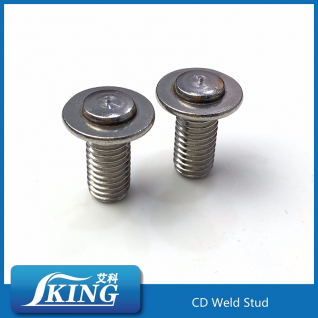
PRODUCT

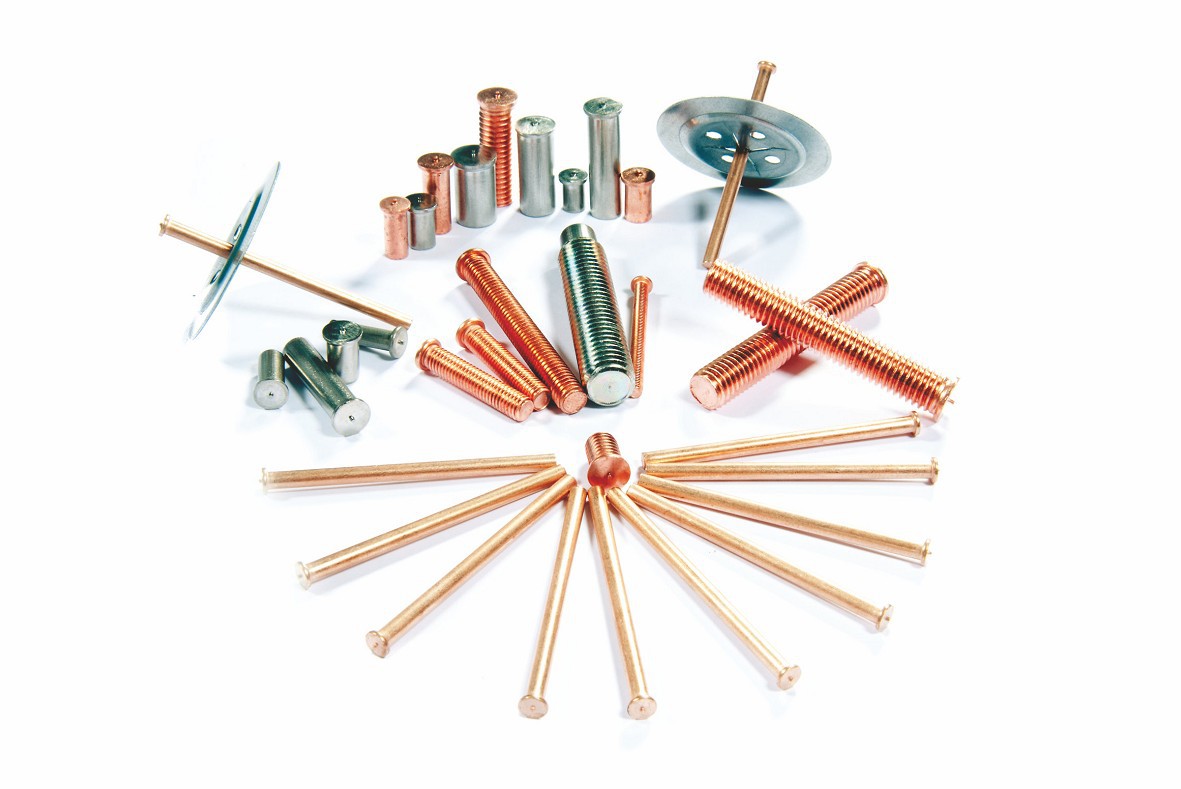


IKING CD Capacitor Discharge studs
Our range of CD weld studs includes mild steel and stainless steel studs, pure aluminium and aluminium alloy studs, and lead-free brass studs. The materials we use are suitable for important relevant EN and ISO industry standards; for example, our aluminium studs are EN 573-3 compliant and our stainless steel CD studs comply to EN ISO 3506-3 (see our specification section below for the full list, as well as a downloadable CD stud catalogue). Many of our CD weld studs are available in threaded, unthreaded, and internally threaded forms, making them suitable for diverse applications.

Product Overview
Capacitor Discharge (CD) Stud Welding is also a semi-automatic arc welding process. However, with CD welding, small diameter fasteners are end-welded to extremely thin gauge parent metal. The CD process operates on the principle of capacitor stored energy, which is instantaneously discharged by the equipment system through a special weld “timing” tip. Since the entire weld cycle is completed in several milliseconds, welds can be made to thin sheet without pronounced distortion, burn-through or discoloration. CD welding permits stud welding of dissimilar metals. The weld stud bolt is engineered for applications requiring fast installation and minimal surface impact.
Technical Data
 Product Advantages
Fast Installation
CD welding allows installation in milliseconds, improving efficiency.
Stable Performance
As a CD stud, it provides consistent welding quality.
Clean Appearance
Minimal marks make it suitable for visible surfaces.
Flexible Application
The weld stud bolt can be used in various industrial and precision applications.
CD Capacitor Discharge Studs Welding Process

In the field of sheet metal fabrication, our fastening solutions are widely used in thin plate structures where traditional welding may cause distortion, providing a reliable alternative.